Eggplant Parmesan
England, Language, Great Food, and Love
My wife and I just returned from a fantastic two-week excursion to England and Scotland. The weather was perfect, a real rarity for the UK. No rain, blue skies, pleasant temperatures, and lots of glorious sunshine. For me the UK is a special place. It’s almost magical. Maybe it’s because England is my ancestral home. Maybe it’s because it’s just that charming.
Now, almost everyone knows that there’s American English and British English. And while the two are virtually the same there are those words and phrases that are different: lift= elevator; servette= napkin; lorry= truck; biscuit= cookie; and so on. In fact, that now ubiquitous “no worries” response that seemed to spring out of our digital world has its roots in British English.
And then there’s aubergine. Eggplant. I completely forgot that linguistic flip-flop when we visited Bill’s on Cheap Street in Bath. Bill’s is a thoroughly charming English pub with great food and that warm, cozy atmosphere that gives British pubs their reputation.
As my wife set her sights on scones, clotted cream, and strawberry jam—Cream Tea, I studied the menu and found an intriguing, exotic offering: Aubergine and Mozzarella Parmigiana. Baked eggplant (aubergine), Parmesan, spinach and tomato sauce topped with green basil pesto & creamy Buffalo mozzarella (wording from their menu).
As soon as our waitress placed the dish on our table and I saw eggplant, I then remembered the eggplant/aubergine word switch. The dish was vaguely an eggplant Parmesan variation. It was fabulous, but it got me thinking about my old recipe for eggplant Parmesan, so when we got home to the US, I wanted to prepare the dish to compare our Americanized version to this British variation.
I’m not too sure which I prefer, but I always get a kick out of preparing this rich dish. My daughter who lives in New York was visiting us when I made it this time, and it was especially rewarding. It reminded me again, that there is no greater joy than cooking for people you love.
Here’s the recipe and a sincere hope that you have those you love close by and can prepare this Americanized classic for them.
Eggplant Parmesan
Ingredients
2 medium eggplants, cut into ½-inch-thick round slices
salt, as needed
4 c. fresh breadcrumbs
1 tbs. dried oregano
1 tbs. dried thyme
freshly ground black pepper
olive oil
3 large eggs, beaten
4 tbs. water
4 tbs. milk
4-5 c. marinara sauce
½ c. Parmesan cheese, grated
1 lb. Mozzarella cheese, grated
Instructions
Arrange the eggplant slices on large platter and sprinkle generously with salt. Set aside for at least 15-20 minutes. This will let the bitter juices weep from the eggplant.
Preheat the oven to 375°F.
Rinse the eggplant slices thoroughly. Blot the slices to dry.
Combine the breadcrumbs, oregano, and thyme in a bowl, and then season with pepper.
In another bowl, combine the egg, milk, and water together.
Dredge the eggplant slices one at a time in the egg mixture, and then dredge in the breadcrumb mixture. Shake off any excess breading and set aside. Sometimes you may need to press some additional breadcrumb mixture onto the eggplant slices if the slice isn’t coated with the breadcrumbs.
Place the breaded eggplant slices on a baking sheet and bake in the oven for 15-20 minutes. Flip them over and continue for 5-10 minutes or until golden brown. Remove and let cool slightly.
Coat a baking dish with olive oil. Cover the bottom of the dish with ⅓ of the marinara sauce and arrange half of the eggplant over the sauce. Cover the eggplant with another ⅓ of the sauce. Sprinkle half of the Parmesan and half of the mozzarella over the sauce. Repeat with the remaining eggplant, sauce, Parmesan, and mozzarella. Bake until hot and just beginning to brown, about 30 minutes.
For this installment of Spicy Old Man, we welcome guest blogger, my wife, Janet Boatwright. Welcome to the Blog, Janet!
JANET WILL BRING THE CHEESESTRAWS
Home is a small town in southwest Mississippi, and, like all good southerners, we visited there often. We ALWAYS had huge family gatherings for Thanksgiving and Christmas. It was tradition that certain holiday treats would be prepared ahead of time so that the grandchildren (my sister and I) could take home plenty of our favorites after our Thanksgiving trip.
Tins of the most amazing treats would be packed in our trunk every Thanksgiving. (You remember--those large round tins that were used year after year—the ones that were a little brown-tinged from being left too long in the oven to dry—the ones that were so warped that aluminum foil would be used to “tighten” the lid, so the treats would stay fresh.) Those tins contained our special holiday treats to serve throughout the holiday season.
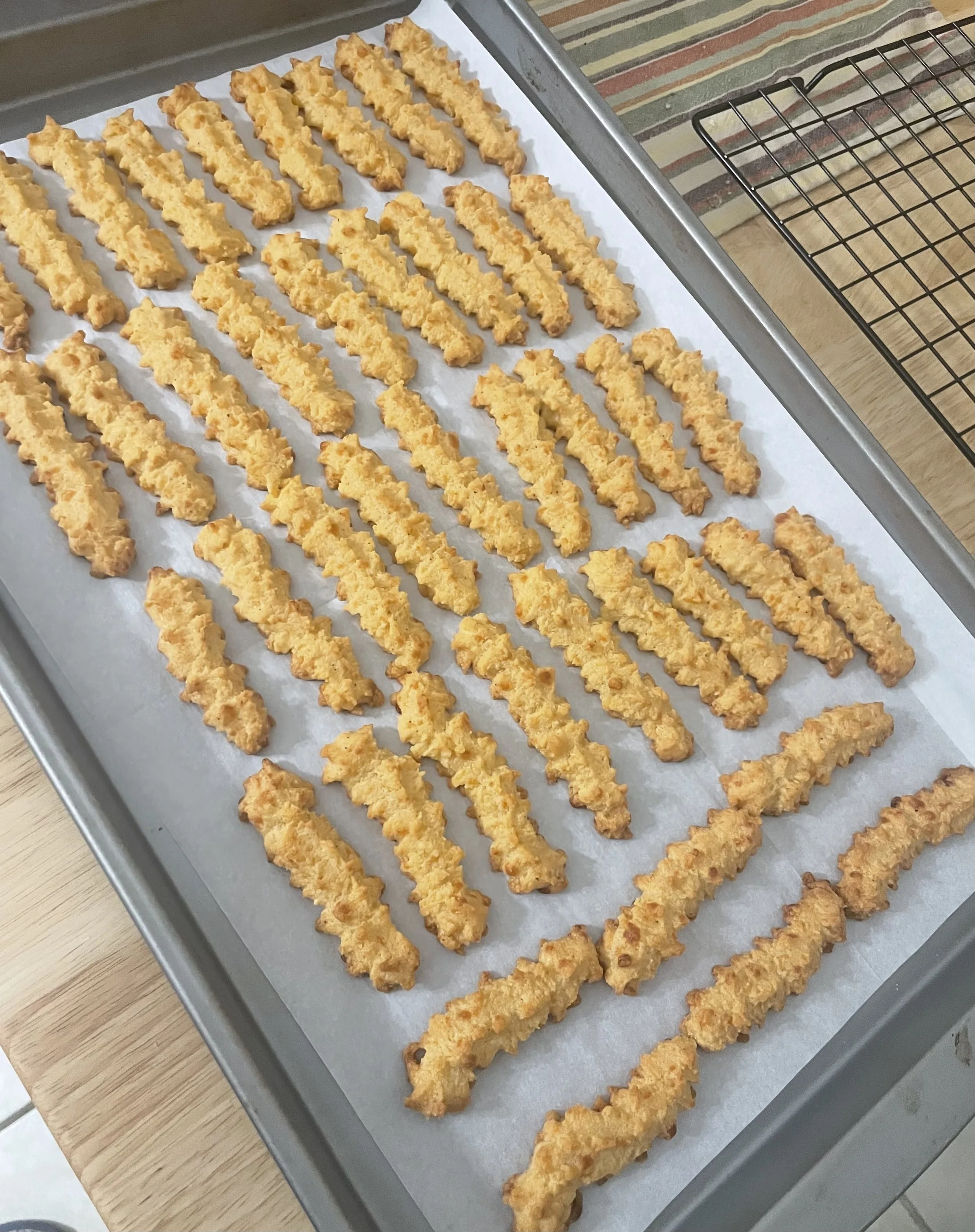
My favorite of these treats was the cheese straws. (I never remember not having cheese straws! We had them even before they became popular.) Yes, my grandmother and great aunt were good cooks, but when it came to holiday cakes, cookies, and certainly cheese straws, they placed their orders well before the holidays—as did most households in our small town—with Janie.
Janie, a legend in our town, lived in a small, unpainted house facing the railroad tracks and was the most productive cook in all of south Mississippi. There was nothing she could not bake. When my grandmother would call to place her holiday order, the conversation would sound something like, “Janie, we need a double order of cheese straws this year. Martha and the girls will be home before Thanksgiving. You know that’s Janet’s favorite. Do you think you could have our Dutch cookies ready by then? And we’ll need your divinity iced cake with lemon filling for Thanksgiving, and the coconut one for Christmas. Oh, and don’t forget Davis’s birthday cake—and DON’T decorate it like Christmas. You know he just hates that his birthday is Christmas day. You just pick up what you need at the grocery story, and put it on my tab.”
On the appointed day, often I would get to go with my mom to pick up our dessert feast. I don’t know how she could do all that wonderful baking in her tiny hot kitchen, but she worked magic. Her kitchen countertops, table, and any other flat surface were lined with baked goods, just waiting to be picked up. Her house must have been the most visited home in Gloster during the holiday season.
Those days are long gone, but I remember them like they were yesterday. My grandmother, great aunt, and even my mother are gone. But I inherited the cheese straw recipe AND cookie press!
I have continued the tradition of making cheese straws every Christmas. It was not until we moved to South Carolina that cheese straws began showing up at every small gathering, but most certainly they were not homemade.
Once, while helping host a woman’s event, I volunteered to make cheese straws. They are always a hit. At least half of the women there asked who had made the cheese straws. From that day on, when we are involved in planning any event, as dishes are assigned, someone will almost always say “Janet will bring the cheese straws”.
CHEESE STRAWS (Gloster)
Ingredients
· 1 lb sharp cheddar cheese, grated (finely grated preferably)
· 1 ½ sticks butter (or oleo)
· 2 cups all-purpose flour
· 1 teaspoon salt
· 1 teaspoon red pepper (or 1/4--1/2 tsp per preference)
Instructions
1. Cut butter into pats and place over the grated cheese.
2. Warm until soft enough to cream.
3. Sift salt, pepper, and flour over it.
4. Add and mix (like biscuit dough)
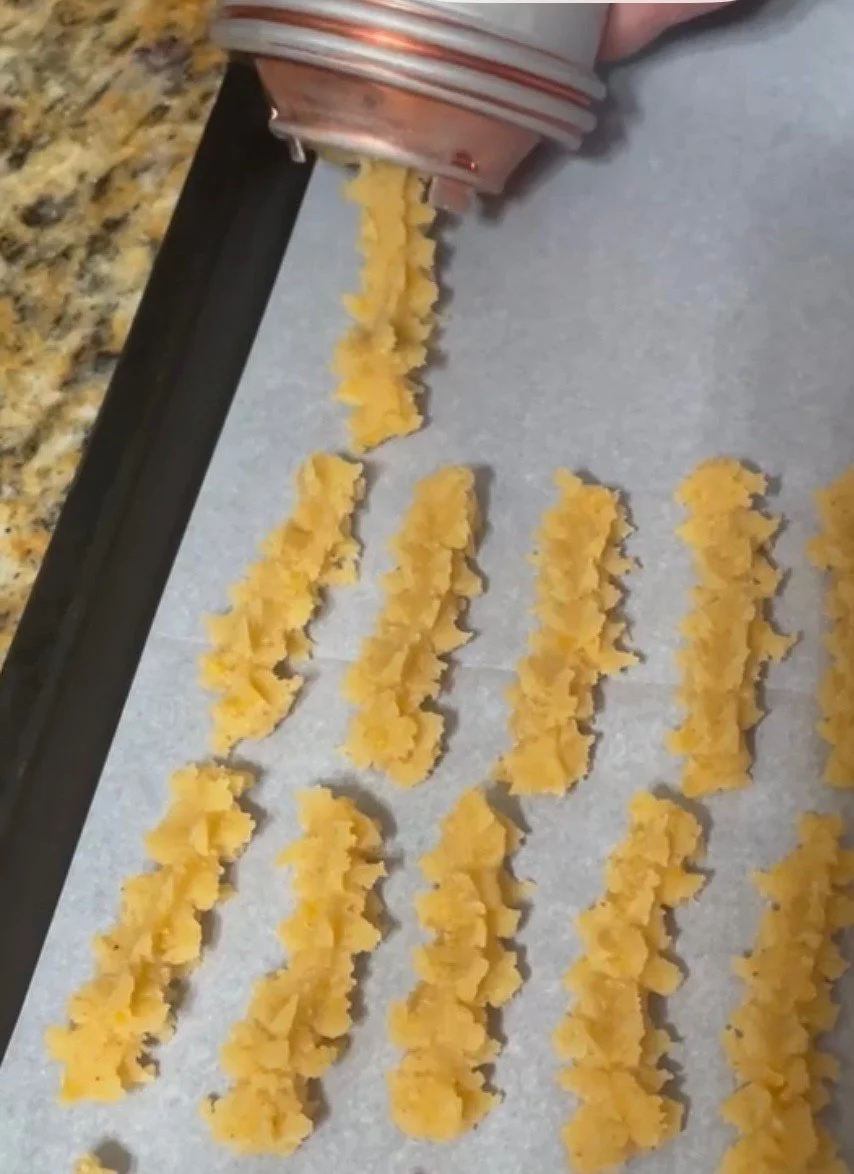
5. Put through cookie press (star attachment).
6. Bake at 350 degrees until lightly brown (approx. 12-14 min)
NOTE:
--I cook 14-16 min. in my oven. Watch carefully last 1-2 min.
--You want them to begin to “brown” to stay crispy. If they don’t, they will not stay crisp.
--The hardest thing is to cream butter and cheese. But if you don’t cream them well, the recipe will fail!
(35 calories per cheese straw, at 115/order. 3820 calories for one recipe.)
That’s What Friends Are For
We moved into the house on 37th Street in Tulsa November 1998, and with little fear of exaggeration I’ll say that by afternoon our new neighbors, the Daleys, we considered best friends. Sometimes you know. Time has taken a rough toll on these relationships, and I seldom see any of them anymore, but I still consider Nancy Arp (Daley) Schooley one of those friends that feels more like family than friend.
This pork tenderloin marinate is Nancy’s invention.
The Daley’s were preparing for one of their gatherings of friends and family complete with, of course, a grill full of pork tenderloins. In true Nancy-style she improvised this wonderful marinate on the fly. I was lucky enough to be in the kitchen with her at the time and made meticulous mental notes on what she was doing. I rushed home, grabbed a scrap of paper and jotted the ingredients down. The old scrap of paper stayed in the “white book” for years until I finally typed it out for safe keeping and clear reading.
As I re-type this simple basic marinate I grieve for the friends I have parted with over the years, some because of death, others because of moves, others because of divorces. But it doesn’t matter why you lose them, it’s always a painful thing. They can never be replaced. Treasure your friends and savor every moment you have with them.